Biotechnology Researcher feels she can now speak fluently in English Meetings

As a biotech and healthcare professional, you may need to participate in many meetings and give presentations.

This may be easy to do in your language, but when you need to do this in English in the U.S. it could be daunting!

Karina messaged me for help because she felt like it was unnatural to speak in English with her colleagues. She has an important job in health and nutrition research as a post-doctorate graduate and needed to have many meetings with colleagues. But, when she participated, she felt blocked.

Over a few weeks, because she always participated in our sessions and worked on our plan, she was able to see significant progress!

Not only did she feel better speaking with colleagues informally, but now she understood what specifically she could improve on in her communication and we discussed where to find resources for sentence structure practice in specific areas, and how to be an active listener.

Karina even practiced a wonderful presentation in which she was able to explain her research at many different levels and discuss the main points without looking at her notes. She implemented all the practices in her busy schedule and I’m so happy for her progress!

If you are feeling stuck or blocked when speaking English as a healthcare or biotech professional, don’t hesitate to connect with me and send me a message!

Client who works in Nuclear Medicine

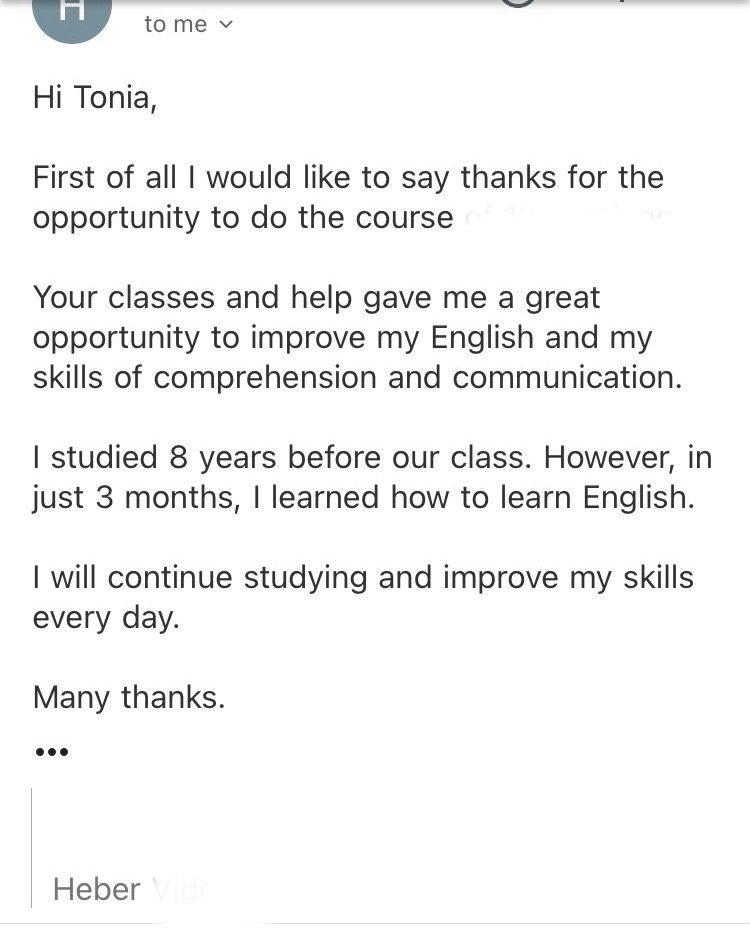
After 8 years of studying general English,

A client of mine who works in nuclear medicine stated that he could not understand his colleagues to hold important meetings with them in English.

What could be done to break the listening barrier?

*We worked on studying the intonation and rhythm of English to understand it better.

*We set up 3-5 specific practices he could do every week.

*We did role-plays in his field of work with questions so he could practice his listening comprehension.

*We found some industry-specific material he could use to practice for an important upcoming seminar and meeting with stakeholders.

In just a few weeks, he felt confident to hold meetings in English, and at the end of almost 3 months, he had a successful meeting with an English-speaking client. He feels the vocabulary he learned to use in this meeting helped!

Also, he understood me and other people more! Despite that he doesn’t get much practice outside of work because he lives in Brazil, he says that the listening methods taught him HOW to study.

My best wishes to Heber and his future goals as he continues to improve and work with me on presentations and speaking.

If you are in the field of healthcare or biotech and are struggling with conducting English meetings, feel free to ask me about my program.

Also, you may connect with me on Linkedin!

Identify your Gaps

Identifying your areas of difficulty can help you to greatly improve. Often though, it is difficult to do on your own.

I’m so happy my client has felt so much improvement and continues to improve.

Do you feel you can significantly improve by focusing on what you need?

Let me know if you agree!


hashtag#saude hashtag#enfermeiros hashtag#medicos hashtag#pesquisaclinica hashtag#clearhealthenglish hashtag#english hashtag#healthcare hashtag#medicalresearch

Three steps to improve your English Communication as a Healthcare Professional

As a healthcare professional, you might feel that you have already learned so much general English from taking years of English courses, only to find that: You have a nagging difficulty with either listening comprehension or speaking and it gets in the way of you making progress. You find that it is difficult to speak in certain situations and this hinders your growth in your career. What is more, sometimes people don’t understand you when you speak, which is frustrating. You’ve spent a lot of time studying English grammar, and even watching TV and listening to English music but English is still difficult for you. You’re still not at the level you want to be in your career. 

  • You are missing out on opportunities You might think it is because:
  • You haven’t spent enough time listening to English.
  • You haven’t spent enough time speaking English with native English speakers. You just don’t have the right resources to advance to the English level you want. 

The TRUTH is, you haven’t been systematically learning English to get to where you want to be.

Let me use an analogy that will help you to understand:

 Let’s say that your Vitamin B12 is low, and your doctor wants you to take a certain quantity of Vitamin B12 to get those levels up. You then decide you can get enough B12 by just taking a Multivitamin. You know what will happen next is that you will never raise your Vitamin B12 levels because you are not focusing on the problem, which is raising your B12 levels.

 It seems very simple, but this is what has happened in your English language journey. You have tried doing all the same things but have not tried a systemic approach to improving your English to solidify your communication fluency, speak clearer, and improve in the situations you need it.

 Instead of continually learning or practicing everything you need to: 

  1. Solidify your communication skills by focusing on active steps to improve listening and speaking fluency and learning relevant vocabulary for your career.
  2. Improve your clarity with correct pronunciation, stress, and intonation so that your colleagues will better understand you.
  3. Improve your English communication skills in meetings and writing skills for the job. 

I help my clients following this exact approach,

 Before working with me they had difficulties with English despite taking general English classes previously and trying to improve on their own.

Now they have tackled either their listening or speaking difficulties and are speaking confidently in situations they never expected. They know what to say in interviews and meetings and also how to write better on the job because we have worked together.

Send me a message, so we can achieve your goals together!